Showing posts with label Bram Stoker. Show all posts

Apr 21, 2009

Alex Bledsoe - Interview and Contest

"He's been a reporter, editor, photographer and door-to-door vacuum cleaner salesman. He now lives between two big lakes in Wisconsin, writes before six in the morning and tries to teach his two sons to act like they've been to town before. He's published more than fifty short stories on topics as diverse as big-game hunters, mermaids, modern witches, Victorian gentlemen and country musicians."

The quote above comes from Alex Bledsoe's own internet site. Bottom line, IMHO, he's a nice guy, an interesting guy, and a terrific writer! His latest work Blood Groove(Tor, April 28, 2009) is a not-to-be-missed vampire novel.

Today he answers questions from PVN. After reading the interview look for contest information. One lucky commenter will win an autographed copy of Blood Groove.


PVN: What attracted you to vampires?

Alex
: At a visceral level it's the power over us mere mortals. More philosophically, it's fun to envision a consciousness that has developed past the normal human life span. Is nihilism the inevitable result? Does depending on other beings, at the level a vampire must, alter your perspective on what you once were, and currently are? Freed from the constraints of time and biological change, what morality even applies to you? Questions like that fascinate me, and I hope come out in the story.

PVN: What are the attributes of your vampires?

Alex
: Stephen King said, apropos of writing "'Salem's Lot," that the brick wall he kept running up against was "Dracula," because it really *is* definitive. Because of that, my vampires have the abilities Stoker gave them, but the twist is that they don't fully know the extent of them; after all, how many of us understand everything about how our own bodies work? So there are still some surprises.

PVN: Baron Rudolfo Zginski - what an interesting fellow - describe this character.

Alex
: I wanted to use the Dracula archetype, so I needed an aristocratic, Old World, Eastern European vampire figure. I'd invented Zginski for a short story many years ago; when I began plotting the novel, I realized he fit perfectly with what I wanted to do, which in high-concept terms was "Dracula Meets the Lost Boys."

Zginski's primary characteristic, and his greatest weakness, is his arrogance. It's not so much based on his disdain for others as on his certainty that he is simply better, smarter and stronger than anyone else. He had these qualities as a mortal, and becoming a vampire just amplified them. And the thing is, he *is* smarter and stronger than almost everyone, but that "almost" keeps tripping him up.

PVN: What sort of research did you do for this book?

Alex
: I'm old enough to remember the Seventies pretty clearly, and I was 12 in 1975, the year in which the book is set. Most of my research involved locking down whether or not things I recall actually happened before or after this date. Teresa Nelson, the Memphis contact for About.com, was invaluable in helping me verify this. I made one deliberately anachronistic choice (if you spot it, it means you were there), but otherwise tried to get everything as accurate as possible. The trickiest part was recreating the attitudes, which were on the cusp of the feminist and civil rights movements becoming truly mainstream. Lip service was paid to equality as a concept back then, but the reality--especially in the South--retained a lot of the old status quo.

The older historical bits, particularly Zginski's plan to turn a profit on the Irish Potato Famine, required old-fashioned grunt work. Luckily, I enjoy that sort of thing.

PVN: Will there be a sequel to Blood Groove?

Alex
: There will be. It's titled "The Girls with Games of Blood," and it puts Zginski between two vampire sisters who have been feuding over men since the Civil War. It will be out in the spring of 2010.

PVN: What authors inspire you?
Alex: In vampire fiction, my taste runs to the classics: "Dracula," LeFanu's "Carmilla," and the long-winded but absurdly fun "Varney the Vampire." In horror fiction I'm a long-standing fan of H.P. Lovecraft, especially "At the Mountain of Madness." In more general fiction I admire Dashiell Hammett, Raymond Chandler, Andrew Vachss, Ross Macdonald, Robert B. Parker, Charles de Lint and William Faulkner.


PVN: Describe your writing day and what your writing environment is like.

Alex
: I'm a stay-at-home parent, so my writing day revolves around my one-year-old son. When he's napping I'm chained to my laptop, and when he's awake, I'm usually editing something with pen and paper. It's a bit chaotic, but I wouldn't trade it for anything.

PVN
: Anything else you would like to add.

Alex
: Blood Groove comes out on April 28th from Tor Books, and on unabridged audio from Blackstone.

PVN: Alex, thanks so much for this interview!


The contest portion is closed.
Now for the Contest information:

One lucky commenter will win a signed copy of Blood Groove

For a chance to win do one (or more) of the following:

*Comment on any subject from the interview. Each comment on a different subject counts as an entry.

*Ask Alex a question. Each question counts as an entry.

*Link to Patricia's Vampire Notes and send me the URL or on Twitter use @patriciaaltner in the Tweet. Each link or Tweet counts as an entry.

Be sure to give me your email information so that I will be able to contact you.

The contest will end Friday April 24 at 11:59 PM ET

Mar 17, 2009

Happy St. Patrick's Day


In honor of St Patrick's Day, when thoughts turn to the Emerald Isle, I have decided to highlight the following book - for obvious reasons.

Dracula's Crypt: Bram Stoker, Irishness, and the Question of Blood. University of Illinois Press (October 15, 2001).
From the publisher: "Dracula's Crypt" unearths the Irish roots of Bram Stoker's gothic masterpiece, offering a fresh interpretation of the author's relationship to his novel and to the politics of blood that consumes its characters. An ingenious reappraisal of a classic text, "Dracula's Crypt" presents Stoker's novel as a subtly ironic commentary on England's preoccupation with racial purity.

Probing psychobiographical, political, and cultural elements of Stoker's background and milieu, Joseph Valente distinguishes Stoker's viewpoint from that of his virulently racist, hypermasculine vampire hunters, showing how the author's dual Anglo-Celtic heritage and uncertain status as an Irish parvenu among London's theatrical elite led him to espouse a progressive racial ideology at odds with the dominant Anglo-Saxon supremacism.

In the light of Stoker's experience, the shabby-genteel Count Dracula can be seen as a doppelganger, an ambiguous figure who is at once the blood-conscious landed aristocrat and the bloodthirsty foreign invader. Stoker also confronts gender ideals and their implications, exposing the 'inner vampire' in men like Jonathan Harker who dominate and absorb the women who become their wives.

Ultimately, Valente argues, the novel celebrates a feminine heroism, personified by Mina Harker, that upholds an ethos of social connectivity against the prevailing obsession with blood as a vehicle of identity.

Revealing a profound and heretofore unrecognized ethical and political message, "Dracula's Crypt" maintains that the real threat delineated in Dracula is not racial degeneration but the destructive force of racialized anxiety itself.

Stoker
's novel emerges as a powerful critique of the very anxieties it has previously been taken to express: anxieties concerning the decline of the British Empire, the deterioration of Anglo-Saxon culture, and the contamination of the Anglo-Saxon race."

If anyone is familiar with this tome I would like to hear from you!


The web site Music for All Occasions offers this album which is available on iTunes.

I can imagine an evening with a pint of Guiness, listening to The Irish Vampires, and reading Dracula's Crypt. What better way to celebrate St. Paddy's Day!

[Just kidding the beer and the book would put me to sleep.]

Jan 14, 2009

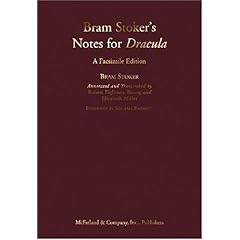
Bram Stoker's Notes for Dracula - Review


Bram Stoker's Notes for Dracula: A Facsimile Edition
Annotated and Transcribed by ROBERT EIGHTEEN-BISANG and ELIZABETH MILLER

Bram Stoker's notes are housed in the "Rosenbach Museum & Library—a small house that has been converted into a museum and rare-book library on a shady, residential street in the center of Philadelphia." (p 1). Having poured through data, the authors show the plot development of Dracula, from a hodgepodge of character sketches, narrative points, conversations, and places, in a way that makes sense for their readers. It is fun to look at facsimile's of Stoker's hand written entries followed by a "translation" in typed written English.

In a recent article I wrote on Whitby, England and its association with Dracula I found Stoker's Notes to be an invaluable source. Of particular interest I discovered that Stoker and his family stayed in Whitby for several weeks and that many of his notes for Dracula were written there.

"He, his wife Florence and their son Noel, vacationed there during the summer of 1890. They arrived in late July and stayed for at least three weeks. By this time, he had begun his novel and outlined his villain. He had originally planned to have his vampire enter England via Dover but, by the time he returned to London, he had found a name for his vampire, had a new location for his villain’s arrival in England as well as a picturesque background for Lucy’s defilement" (p 288).

Stoker originally planned to have the unfortunate ship, Demeter, come ashore in Dover, but after his stay in the picturesque village of Whitby a new location was used.

This book is so comprehensive that I find it difficult to summarize it in a way that shows what a treasure of information it contains. One of the most daunting tasks for the authors was the deciphering of Stoker's cramped writing. Of course he wasn't writing for others only for himself. But how fortunate that these notes were made, and kept, and found! And now put into a readable form. For any writer, whether a Dracula fan or not, it is fascinating to watch the process unfold. The reader discovers which notes become part of the novel almost in their entirety, others which have a vague resemblance to some circumstance in the story, still more that make no appearance at all. We owe Miller and Eighteen-Bisang a debt for their laborious work on the Notes as well as the detailed footnotes and the extraordinary essays they added which put so much of what occurred in the novel into historical context.

Both thumbs up on this book!

Be sure to visit Elizabeth Miller's site - Dracula's Homepage Here you will find everything you ever wanted to know about the nefarious Count.

Jan 12, 2009

A New Annotated Dracula


The New Annotated Dracula edited by Leslie S. Klinger with an introduction by Neil Gaiman. (Norton, 2008) Read his introduction at Times Online.

From the publisher: In his first work since his best-selling The New Annotated Sherlock Holmes: The Complete Short Stories (2 Vol. Set), Leslie S. Klinger returns with this spectacular, lavishly illustrated homage to Bram Stoker's Dracula. With a daring conceit, Klinger accepts Stoker's contention that the Dracula tale is based on historical fact. Traveling through two hundred years of popular culture and myth as well as graveyards and the wilds of Transylvania, Klinger's notes illuminate every aspect of this haunting narrative (including a detailed examination of the original typescript of Dracula, with its shockingly different ending, previously unavailable to scholars). Klinger investigates the many subtexts of the original narrative—from masochistic, necrophilic, homoerotic, "dentophilic," and even heterosexual implications of the story to its political, economic, feminist, psychological, and historical threads. Employing the superb literary detective skills for which he has become famous, Klinger mines this 1897 classic for nuggets that will surprise even the most die-hard Dracula fans and introduce the vampire-prince to a new generation of readers.

Note: The Graveyard Book (I listened to on my long drive from Columbia, MD to Akron, Ohio), is a terrific yarn as narrated (and written) by Neil Gaiman. The story is about a boy named Nobody Owens, Bod for short, who as a toddler lost his parents and sister to a murderer called The Man Jack. The baby boy find safety in a nearby graveyard with its ghostly inhabitants. Mr and Mrs Owens who in life never had a child of their own adopt Bod as their son, and Silas, who is neither dead nor alive (ok, he's a vampire) agrees to act as Bod's guardian.

Jan 5, 2009

Whitby, England and Dracula


On a trip around the north of England I boldly suggested a drive to Whitby. I knew of this town because of Bram Stoker's Dracula. It was on these shores that the Demeter crashed one dark and stormy night. The crew were either dead or missing. Silly as it may sound this was my sole reason for wanting to visit Whitby. This would give me bragging rights to my vampire aficionado acquaintances.

When we left York rain poured down making driving difficult at times. Fortunately my English friend was at the wheel. I never did get the hang of driving on the left. So while she drove I took out the guide book and read about Whitby. It shocked me that only one minor reference to Dracula was made. More importantly I discovered that "Whitby is one of the most interesting and attractive towns on the British coast. " This has been true for many years. In fact Bram Stoker spent several week with his family here during the time he was writing Dracula. Originally Stoker had meant Dracula to enter England via Dover but he was so enchanted by Whitby that he changed his mind and set three chapters here.

In Chapter 6 of Dracula, Muna describes Whitby this way, 'This is a lovely place. The little river, the Esk, runs through a deep valley, which broadens out as it comes near the harbour. A great viaduct runs across, with high piers, though the view seems somehow further away than it really is... The houses of the old town are all red-roofed, and seem piled up one over the other anyhow, like the pictures we see of Nuremberg. Tight over the town is the ruin of Whitby Abbey, which was sacked by the Danes, and which is the scene of part of 'Marmion,' where the girl was built up in the wall." (The story goes that a young novice during the middle ages became pregnant A big no no of the time. As punishment she was bricked up in a wall while alive. I am going to assume this is a myth and not at all true.)

My friends and I enjoyed our outing in Whitby with its lovely shops, restaurants, and active harbor. Perhaps because of my reading of Dracula my eyes would drift up to the Abbey ruins high on the cliff. As beautiful as they were I could easily imagine them to be quite creepy, at night when the full moon gleamed and the wind howled, and perhaps a north sea storms passes through.

Mina writes of the scene where helpless witnesses watch as the Demeter comes perilously close to shore. The search light shines the way to safety but the hapless ship has no relief from the tossing waves, "The searchlight followed her, and a shudder ran through all who saw her, for lashed to the helm as a corpse, with drooping head, which swung horrible to and fro at each motion of the ship.... The ship, as if by a miracle, had found the harbour, unsteered save by the hand of a dead man!... The schooner paused not, but rushing across the harbour, pitched herself on the accumulation of sand and gravel washed by many tides and many storms... There was of course a considerable concussion as the vessel drove up on the sand heap... But, strangest of all the very instant the shore was touched, an immense dog sprang up on deck from below, as if shot up by the concussion, and running forward, jumped from the bow on the sand..."

Thus landed Count Dracula on England's shores. It's doubtful he took the time to enjoy the beauty of this seaside town. Of course, most establishments would probably closed so late at night, and Dracula had many other things on his mind. If you don't know what those things are you must read the book. Even today, more than 100 years later, many people consider it the scariest book they have ever read. Why not do things right take a holiday in Whitby, sit near the ruins of the Abbey, or the nearby cemetery and read the book there.

Although much of the information in this article came from my own notes of my visit, and from Bram Stoker's classic novel, I also found great ( and entertaining ) information in a book called Bram Stoker's Notes for Dracula: A Facsimile Edition Dracula: A Facsimile Edition
by ROBERT EIGHTEEN-BISANG and ELIZABETH MILLER. Don't let the academic title push you away. It is utterly fascinating!

Originally written for Lori Devoti's blog and her special promo 30 Days of Vampires.