May 18, 2011

Michael J Martineck - Guest Blog, Vote Tour, and Contest

Please welcome Michael J Martineck whose story Cinco de Mayo is a finalist in Alberta Reader's Choice Award. Edge Science Fiction and Fantasy Publishing is celebrating his book today with a guest post on Patricia’s Vampire Notes

If you wish to support Michael in his quest to win the award, and would like to vote, you can do so by visiting www.albertareaderschoice.ca , selecting Cinco de Mayo and pushing vote.  You are allowed to vote once every 24 hours from any IP address.  Once you have voted, please tweet “Viva Cinco de Mayo! I voted for it. Join all of us in supporting Cinco – a book for the people of the world!"  When we see that, we will know that your vote came from this blog post. 

CONTEST: One lucky person who posts a question in the comments section will win a signed copy of Cinco de Mayo, sent out at the end of the month. Be certain to include your contact information.


They’re all vampire stories 
by Michael J. Martineck

I’m thrilled Patricia’s letting me guest blog - despite the fact that my novel, Cinco de Mayo, hosts no undead – as it gives me the chance to discuss my belief that vampires remain constant in literature because . . . all writers are vampires.

In Cinco de Mayo everyone in the world is suddenly and inexplicably paired with someone else on the planet.  Each person receives a full dose of the other’s memories.  When asked, people recall two names, two first kisses, two complete lives.  The novel follows several pairs as they deal with the new-found intimacy, or try to stay alive.  Some people have learned a bit too much.

To write a novel that spans the globe, I had to feed on people I’ve known over the years, friends and acquaintances from across the world.  I felt like a vampire, sucking out experiences, feelings, emotions, most of the time from unwitting victims.  Hell, I was frequently unwitting.  I collected pieces of people’s lives long before I knew I would write this book.  I’m betting a lot of writers prey on people they know, overhear on the bus or observe, in a dim restaurant, through the corner of the eye.

This novel is hard to classify – a shot of science fiction, some paranormal, the pace of a thriller – in the end, all novels are the same.  They’ve all vampire stories, as written by vampiric writers.

About the book


Cinco de Mayo tells the powerful tales of individuals around the world and their “others”:

A transit worker whose sudden knowledge of one of the leaders of the Aryan nation marks him for death.

A rich playboy from Abu Dhabi who vows to save his “other”, a child slave in a carpet factory in India.

A New York advertising executive who suddenly gets a new view on his own life through the eyes of a blind railroad worker in China.

An abused housewife who suddenly has the skills and knowledge of a Swiss Air Marshall.

There is a  Cinco de Mayo story for everyone, a character in this book that you care about, maybe even love…a life that speaks to you and touches your heart.

No matter where you may be…

May 15, 2011

Hell Can Wait - Fantasy Book Review

Hell Can Wait 
by Theodore Judson
EDGE Science Fiction and Fantasy; 1st edition (October 15, 2010)

Have you ever wondered what happened to Maternus, a Roman soldier who led a failed rebellion against the Emperor Commodus in 186 AD? (Russel Crowe comes later) Well, neither have I, but fortunately for readers Theodore Judson did  and has written a brilliant, humorous fantasy about the bonds of friendship and the eternal nature of love.

 Maternus has literally gone through Hell. A bureaucratic screw up kept him in this most undesirable place for close to 2,000 years. Eventually the mistake was caught, and Matt finds himself in the 21st Century where Mr Worthy, an angel, has decided that even though Matt was a thuggish, brutal Roman soldier he had also shown qualities of decency - like sparing the innocent and feeling a special love for a saucy young lady. It's therefore possible, says Mr. Worthy that Matt can earn redemption. The demon adversary Mr Banewell, not wishing to lose a resident, challenges this assumption. With some acrimony the two finally agree that Matt must pass three tests before entering the pearly gates.

As for locale these are the parameters:
"He has to be among the unfamiliar, in some nation that could not have existed in his lifetime. There have to be independent women who are able to stand up to him, and lots of bothersome children to distress him. Put him in an affluent place, somewhere that would not know or pardon his type of violence.”

Mr Banewell suggests Aurora, Colorado, just outside Denver. Mr Worthy agrees.

To help Maternus (now known as Matthew August) make his way in this new world he is given the gift of literacy, however, his references are still to the 2nd century. Thus Mr. Worthy shows him a building with a cross on it and Matt assumes it must be a place of execution. While applying for a job as janitor at a middle school he is asked about previous employment. Matt answers honestly that he was in the army.  His numerous scars attest to combat. Where did he fight?. Mesopotamia he answers and his educated audience nod in understanding. Matt is surprised to discover that war still rages in the area.

Because of his strange mannerisms and odd way of speaking Mr Worthy advices him, if asked, to say he is from Montana. This works.

It's tough going at times but Matt, with the help of a library card, educates himself, by reading all the great books. He even makes friends which is a new concept for him. These friends unwittingly help him with the difficult tasks assigned by his supernatural watchers.

This was a thoroughly delightful book that believably portrays Matt's fish-out-of-water experience in a modern day American suburb. Judson gets everything exactly right. I can't recommend this book highly enough.

[This book was sent to me by the publisher. Thank you!]

May 9, 2011

Lorelei Bell - Guest Blog and Contest

Today's special guest is Lorelei Bell author of the thrilling romantic adventure Vampire Ascending

Lorelei is offering an electronic and a paper copy of her novel to two lucky readers.

Please welcome her.


By Lorelei Bell

Then those flecks of ocean fell on me. His smile grew broader as he rose—and kept rising. I suddenly had to revise my first assumption—he was impossibly tall, possibly seven foot tall, with a powerful chest, as though he had swung a broadsword at some point in his very distant past, or, as a hunter, carried a huge carcass home on his shoulders when he was a living man. As an undead, he was possibly the largest vampire I'd ever seen. Even without his superhuman powers, he could throw any one of us across the room. ~ Vampire Ascending

I never quite understood my own attraction to vampires, or certain evil—or thought of as evil—creatures such as vampires, werewolves and whatnot. However I've read somewhere that we have this strange attraction for such things, possibly for the most part we are curious, more than anything. But I've had an obsession for vampires since my teens when I watched old horror classics of “Dracula” on TV late at night. I didn't quite agree that Dracula, or vampires in general, should have been the heavy, or villain. I thought, “Why couldn't Dracula get the woman of his desires? Why couldn't he fulfill his love or lust just like anyone else?”

So, later, when I began to pen my stories, I strove to give my vampires personalities, make them seem like regular people, not those you read about even now, where they seem to have no emotions or feelings, have no interest in love, or are devoid of emotion. Also, I asked myself, why do they have to be “dead” or “undead”? My vampires actually do have a heartbeat (but it's rather slow), and want to be involved with someone, perhaps even those of their own ilk.

In my book,  Vampire Ascending, you will find that my vampires are more multi-dimensional, and have more than blood drinking on their mind. Sometimes it's sex, but, hey, there are other things that occupy their minds, like ruling the North American Vampire Association.

My heroine, Sabrina Strong, had to learn quickly how to keep from becoming a victim, and that proved to be a trying beginning for her, fraught with a myriad of dangers. Those vampires who she must trust may become her worst enemies. Like seven-foot tall, over 1,000 year old Viking, Bjorn Tremayne, owner/CEO of Tremayne Towers in Chicago who hires her to find the murderer of his life-long mate Leticia, who is ultimately attracted to her sanguinely as well as sexually. And then there is Nicolas who becomes Sabrina's romantic interest . . . but can she really trust him?

When it came to creating my story, and my heroine in this series, I chose not to go with the kick-ass chick who went after vampires, demons or whatnot (as in Karen Chance, Keri Arthur, and Kim Harris novels), right from the start. I wanted to develop a reluctant hero, Sabrina Strong—a sometimes quirky twenty-one year old Touch Clairvoyant—throughout the series.

Synopsis:

Sabrina Strong is a Touch Clairvoyant who knows a secret. She knows her mother was turned into a vampire when she was ten. Now that she is grown up, a powerful magnate in the Chicago business world hires her to reveal the identity of who ruthlessly murdered vampires in his ultra-modern stronghold of a hotel.

Sabrina is not thrilled about the aspect working for vampires, but she needs the money, and she wants to find the gorgeous and mysterious vampire who has been turning up in her dreams. Is he the one who bit her when she was ten, marked her for his own, and turned her mother so long ago?

Little does Sabrina know that her whole life is about to change as her best friend becomes a victim, too and Sabrina is the only one who can find her. Her friend's fate intensifies the desperate need to find the murderer and, consequently, brings her into contact with a rogue vampire, Vasyl—who looks very much like her dream-vampire.

Sabrina is quickly immersed in romantic trysts and dangerous situations involving scheming vampires, shift changers, and werewolves.

To see a first chapter and more reviews go to: http://vampireascending.copperhill.com/

Visit Lorelei's Muse at: http://loreleismuse-lorelei.blogspot.com

“Vampire Ascending is an action-packed plot full of surprise. Bell delivers a well written and satisfying story that will leave the reader wanting more.” ~ Copperhill Media

“A truly extraordinary vampire tale . . . something to sink your teeth into . . .” ~ Reader Views

“Bell . . . delves into the gritty, violent, dark and sexual world of Anne Rice's vampires . . . a breath of fresh air . . .” ~Tony Martin, Northern Star


CONTEST

*Lorelei is offering a copy of both an eBook and a softbound of  to two lucky readers.

*Please leave a comment for her about this post for a chance to win, and which you would prefer: eBook, or softbound.

*Be sure contact information is included with your comment.

*Contest ends Tuesday May 10th, 2011 @ 11:59 EST

 *Contest for US only.

May 5, 2011

Jeff Bennington - Blog Tour and Contest

Please welcome Jeff Bennington as he tours the blogosphere to let readers know about his new supernatural thriller REUNION. One lucky commenter will win a Kindle! [See contest details and a synopsis of the story at the end of the post]

A True Ghost Story
By Jeff Bennington


In the fall of 2010, my wife and I went on a weekend getaway with some friends of ours. We rented a really cool cabin in Nashville, Indiana equipped with hot tub, gas grill and pool table! Nestled in a cozy hillside, the joint had a beautiful wraparound porch and an exquisite view of the southern Indiana countryside. The sun shone through the trees, the air felt crisp and cool and I just knew I was in Heaven.

We unpacked, started the gas log and settled into our perfect retreat. We had a fun evening planned of cards and watching horror flicks, but decided to head into the tiny town on Nashville to walk through the many shops and galleries. Before we returned, we planned to stop by the ice cream shop and order one of those humongous sugar cones of hand-dipped ice cream. The evening went as planned and we returned to our cabin ready to warm our bones and watch House on Haunted Hill; a perfect movie for snuggling.

Before I knew it, the other three began to fall asleep and we decided to hit the sack.

A couple hours later, around 2:00 a.m., I woke up dripping with sweat. The upper loft apparently had very little airflow. I felt so flipping hot I couldn’t stand it. My wife slept like a baby. I had to get out of there!

I lumbered down the steps and listened to every creak and crack in the rafters. The wind had decided to begin whistling, and I knew I was in for a royal treat. When I stepped down from the stairway, I peered at the leather couch. It looked so cool and inviting. I imagined sprawling out into its cushiony spread. But then I heard a noise, and quite naturally, I turned my head and at the same time my skin melted off my face.

I didn’t see anything unusual. The open concept left nothing to hide. The stairs opened to the living room, dining room and kitchen. Our friend’s bedroom and bath were the only other rooms, and they were attached to the kitchen. After giving the cabin a final inspection from where I stood, I lay down on the couch, snuggled into my bed sheet and closed my eyes…but the noises continued.

I tried listening, listening really close, but the little squeaks and groans seemed to be coming from every direction. No big deal, I thought. It’s just a cabin. Get over it and just fall asleep. And then, something curious happened. The creaking floorboards began to move closer to me. One at a time I’d hear what sounded like a footstep roll softly across the wood floor, pressing gently down, trying not to be heard. My heart, as you can imagine beat madly in my chest, nearly bursting through my ribcage. I looked through the TV screen to see if there was anyone walking, but I didn’t see anything. Then when this thing, whatever it was, pressed into the floor right next to the couch, I couldn’t take it, I sat up, turned my head toward the open space and heard a voice forcefully whisper, “Heeelllloooo!”

This wasn’t a quiet, don’t let them hear you whisper. Oh, no! This was a, I’m not presently living in your dimension, so I’m screaming at you type of whisper. I panicked, jumping straight up like a cat, nearly falling off the couch. It didn’t help that a globe shape lamp stand stood right beside me! I noticed the silhouette of the lamp as soon as I turned around, adding to my near death experience. Seconds later, I realized that the shape beside me was only a floor lamp, but that didn’t make me feel any better. My heart continued pounding like a sprinters feet in the one-hundred-yard dash.

From that moment on, for at least thirty minutes, I felt an electric energy buzzing through my body and felt as if something had hovered over me, almost nose-to-nose, staring at me. I peered through the corner of my eye but couldn’t see anything—nothing physical anyway. But I knew in the deepest part of my soul that something was there. I felt absolutely petrified, frozen in place, like a freshly discovered icy Neanderthal in the Tibetan icecaps.

My eyes searched for movement, but found nothing. I did see, however, a showy figure moving side to side in the reflection of the microwave door. It was the strangest thing. There were no ceiling fans spinning or curtains waving. Everything stood still…everything except the dancing shadow. At that point, I couldn’t take it anymore. I ran back up the stairs to my personal boiler room and slid under the covers with my wife. Still, I never felt alone.

After several minutes of fighting my fears, I finally fell asleep.

The next morning, I woke to the smell of biscuits and gravy and the sound of coffee percolating in the kitchen. My wife and friends, like myself, were shuffling our feet like the undead, trying our best to navigate with squinted, puffy eyes. We eventually sat down to eat.

In a moment of silence, Sarah, my friend’s wife asked if anyone heard anything in the night. I looked at her curiously and asked why. She said, “Because someone was tugging at our doorknob, off and on, for about an hour sometime around four in the morning.” She thought we had mistaken her room for the bathroom, but she was too tired to get out of bed. I then proceed to tell everyone of my experience, and I affirmed to her, and the other two, that I never left the living room until I ran upstairs, and I never walked toward their bedroom.

We all sort of let our suspicions cool for a while. But then my buddy opened up the guest logbook; the kind that each visitor can leave a message to the cabin owners about their experience. And wouldn’t you know it; the book was filled with story after story about a spirit that inhabited the structure.

They called him Earl.

Some of the visitors claimed that he was a gentle ghost, mostly curious, and only somewhat troublesome. Others rebuked the owners for not disclosing the fact that malevolent spirits had haunted the cabin. Me? I don’t know what that thing was, but it scared the hell out of me.

The upside of that experience is, when I write supernatural thrillers, I can honestly communicate what it feels like to be petrified by something that you can’t explain. I know what it sounds like when it’s moving toward me. I know that electrifying sensation when a ghost is standing beside me. Also, I know that there are things out there…things we can’t see. But I also know that where there is darkness, there is also light, and that is all I need to know to keep my sanity.

-Jeff Bennington
Author of REUNION and the blog, The Writing Bomb


CONTEST

Thanks for reading. Be sure to “Follow” Patricia’s Vampire Notes, and then (if you like) purchase or donate a copy of REUNION to your library, available in print, Kindle, Nook and all digital formats.

If you comment on today’s post and email me at reunion.kindlegiveaway@yahoo.com, you’ll be eligible to win a Kindle on May 15th. Go to http://www.jeffbennington.com for details.


REUNION Synopsis

David Ray killed eight students and then turned the gun on himself. He thought the shooting and suicide would fix his world. It didn't. The massacre threw Tanner Khan and the other survivors into chaos.

Twenty years later, Tanner and his fellow classmates reluctantly agree to hold a reunion to lay the past to rest. Although they suffer from Post Traumatic Stress Disorder, they come back to their hometown and reunite in the defunct school building. Old flames are rekindled, fears are ignited, and their lives are about to explode in a whirlwind of memories, haunted by the spirit of David Ray.

Once inside the old school, they discover that a dark entity has joined them. It has come to collect a debt, long overdue, and someone has to pay. Will Tanner and his classmates overcome their fears and put the pieces of their lives back together, or will they be consumed by their worst nightmare?

May 3, 2011

A Loose History of Vampires by Stefan Petrucha - Essay

To celebrate the recent release of the Twilight satire, BREAKING DOWN, author Stefan Petrucha has penned this short piece on everyone's favorite bloodsuckers

Me and the Fangs – A loose history of Vampires


The vampire — monster, metaphor, lifestyle choice, high school crush. Love ‘em or not, their persistence as a cultural meme seems as immortal as the wacky critters themselves. Be it coincidence or a desperate attempt to cash in before the craze dissipates in the rays of the rising sun, I’ve recently penned not one, but three vampire tales, ranging from the paranormal thriller, Blood Prophecy, to Nancy Drew: Vampire Slayer, and last but not least,  BREAKING DOWN, a graphic novel parodying the popular Twilight saga.

But where do these creatures of the night come from? Why are they here? Will they loan me some money? Through all this writing, I couldn’t help but ponder the question. What follows is one man’s admittedly narrow view of a phenomena that will no doubt outlive us all.

Though variations appear in ancient Rome, China, and (dubiously), Native American mythos, the undead we know and love began in the Balkans (yep, Transylvania) as a plague metaphor, enjoying spates of popularity in Europe and colonial New England. Short version – someone dies from disease, returns by night, and infects the rest of their family until staked, decapitated, or both. They were dead, they wanted to kill you, they had to be destroyed — the ethical equivalent of Uncle-as-zombie, sans flesh-eating.

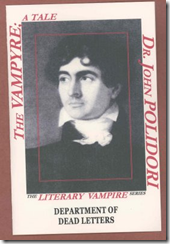
The earliest fictional vamp, Lord Ruthven from Polidori’s The Vampyre (1819), is tad different. Like a more famous Count, and in a similar idiom, this nobleman spends his time sucking blood, seducing virgins and returning from apparent death to attempt feasting on our poor narrator’s sister.

It was a start. More interesting is the 1845 penny dreadful, Varney the Vampire, generally credited to James Malcolm Rymer, though sometimes to Thomas Preskett Prest (your guess is as good as mine as to why). Penny dreadfuls, btw, were the British comic book of their day, fast, cheap and out of control, featuring oft-serialized tales that were as sure to corrupt the youth as today’s video games.

Varney, a precursor to Barnabas Collins, actually tries to get out of his curse. He even commits suicide. In a scene out of the Frankenstein movies, Varney’s brought back to life via galvanic energies (electricity to you) by a Dr. … wait for it… Chillingworth.

The two elephant-corpses in the room remain Joseph Sheridan Le Fanu’s Carmilla (1872) and Bram Stoker’s Dracula (1897). I’ve tried reading Dracula, I think I finished, and, yeah, it’s a seminal horror text and all, but the story, in any form, bores me to tears — with two exceptions. Browning’s 1931 Universal film version has Dwight Frye’s unforgettable portrayal of the Count’s genuinely creepy assistant, Renfield. I also enjoyed a little-known BBC adaption starring Louis Jourdan, but mostly because of Frank Finlay’s totally whack Van Helsing. Beyond that, though, I just don’t really care about anyone in the story, least of all Dracula, be he Lugosi, Lee, Langella, Oldman, or my own fetid imagination. He’s kind of just this great idea without flesh and blood. (Well, that makes sense, doesn’t it?)

For my money, the female vampire Carmilla, steeped in plague imagery, is much more intriguing. Yeah, sure, there’s the barely concealed lesbianism, which I love as much as the next guy, but really, the relationship between the titular vampire and Laura, her lonely victim, is genuinely touching. After the forces of goody-goodness win, Laura is forced to see Carmilla as a lifeless predator, yet she still misses her, and this is clearly not the effect of a curse, but a genuine emotion.

But Dracula got the sales, the stage play, the movie franchise, and it’s his name that’s all but synonymous with the beast itself. Something of course must be said for sheer survival. So, hooray.

Acquiring a kind of Marvel-superhero sheen in the later Universal films, (the rib-tickling mash-ups House of Frankenstein and House of Dracula), Dracula went from dull to cliché faster than it takes to charge an electric car (originally available at the time the novel was written!). As a character, he was most interesting in the spoof, Abbot and Costello Meet Frankenstein, where at least he had a magic ring, some surgical skill, and a quest – to transplant Costello’s brain into the creature. Why? Supposedly to make him a better servant, but really, I think it was just for yucks.

Skipping a few decades, the thickest nosferatu-root, for me, remains the 1960s soap opera, Dark Shadows. As a writer, I’ve been fortunate to work with several iconic characters, from man-made monsters to the world’s first girl detective, but the main reason vampires own a special place in my heart is that moment when I was eight and first glimpsed Barnabas Collins baring his fangs – an affection I blog about at length here.

Yes, it was cheaply made. Sets wobbled, actors blew their lines and the blooper reel is nearly as long as the series. Yet Barnabas, a tortured Byronic hero, owes as much to Wuthering Heights’ Heathcliff as he does to Varney or Dracula. Laugh if you will, but without him, the works of Anne Rice, Buffy the Vampire Slayer, and Twilight, would not be possible.

It’s in him the notion of vampire as someone trapped reaches fruition. Barnabas had a soul, and thanks to it, whined constantly. He even planned to turn his betrothed, Josette, into a vampire like himself, but she threw herself off a cliff, setting in motion our hero’s long-lasting obsession.

Does he ever get on with his un-life? No. The fiend finds one chick after another whom he believes to be Josette’s reincarnation. Eventually, he didn’t even care if the woman looked like Josette. He was just fine finding someone he could dress up in that musty old wedding gown.

And that concept neatly fulfills an essential trope of the old-style vampire – being completely, hopelessly, eternally stuck. Old school Vampires do not change. They do not progress. They do not grow, not emotionally, not spiritually. They do not let it go. They keep checking Facebook even if they have no friends. That’s because they’re dead. Static. Their hunger for blood is a clear symbolic yearning for lost life.

Which brings me to my own Blood Prophecy, which on the one hand harkens back to the notion of vampire as plague, embodied by the evil Skog, but also to the Dark Shadows idea of salvation, through the protagonist, Jeremiah Fall. Rather than a rich Collins, though, Jeremiah is a simple farmer, a pious Puritan.

Puritanism crystallized a lot about vampires that I wanted to say. They had an intense distrust of not only their own hungers, but of the physical world itself (it is the Devil’s, after all), yet they knew they had to live in it. Their quest for salvation drove them stiff and twitching to wonderful innovations (the idea that each person had to read for themselves, for instance) as well as horrific cruelties like the Salem Witch Trials.

Speaking of the real world, 1972’s Night Stalker TV-movie, produced by Dark Shadow’s Dan Curtis, remains one of my favorite vampire films, and not so much because of the vampire. The baddie, Janos Skorzeny, at least so far as we get to know him, is a sheer predatory monster, characterized by feats of strength more in keeping with the Frankenstein monster than a sly seductor.

The film works for different reasons, primarily because of a 16mm, grainy, noir-ish, holy crap it’s real feel. That zeitgeist giddily takes us giddily all the way into The X-Files and its cagey and equally delightful bastard-child, Fringe. Moonstone Books has since kept Carl alive with a series of graphic novels. (I was happy to have contributed The Devil in the Details, which was nominated for a Stoker Award.)

Anne Rice’s Interview with the Vampire and its sequels certainly earned their following, but for me, steeped in Dark Shadows, it all had a been-there-done-that feel. I did enjoy Claudia, in both book and film, but the whole vampire-coven thing never did much for me. It always seems to dilute the sense of a more personal hell. One demon is terrifying, a bunch of them is, well… kind of a party.

Stepping up to more recent times, there is the oft-brilliant Buffy the Vampire Slayer. When Joss Whedon is on his game he is a master. Now, as co-author of the popular Nancy Drew graphic novel series (along with Sarah Kinney and artist Sho Murase) I’d like to say the Buffster’s a direct descendant of the girl detective, but that’s not completely true.

As intellectuals have discussed to death, Buffy’s a reversal of the vampire’s victim, the historically abused female taking control. The popular image of the vampire leering over the sleeping blonde virgin takes a huge turn when the sleeping blonde has a stake in her hand and knows how to use it. And Joss, bless him, plays around with the whole reluctant-vampire thing. While most of his vamps are generic monsters, some are “cursed” with souls (another reversal), drawing a neat line from Angel to Barnabas and back to Varney.

Buffy certainly has Drew in her blood though. Nancy, first published in 1930, is the original mass media girl power figure. Like Buffy, she doesn’t accept a passive role. She speaks truth to power. She has abilities far beyond the norm (in her case, brain-power). She goes after baddies, no matter the risk, a role she seems born to, and her personal life suffers because of it. Sound familiar?

When the first series of graphic novels from Papercutz came to a close after 22 books, Sarah and I were asked to help re-launch Nancy. That meant thinking about what made the character tick in the first place, taking a look at the history and pondering wither she’s wandered since.

Of course Buffy came to mind, and the two-part Nancy Drew: Vampire Slayer was born. Having our girl appear on the cover with a cross-bow in hand and the devilish, handsome Gregor hanging upside behind her may seem like a wild departure, but it’s really tapping back into the myth that’d kept the character going all these years. Without giving away too much, of course we remain true to what Nancy Drew is, though she does share a kiss with the purported vampire, and seems to like it. The books are a lot of fun, a wild ride, and embrace that oxymoronic element the public insists on with beloved characters – exactly the same, only different.

As for vampires, like Nancy, in order to survive, they need more than just blood, they have to adapt. Sadly, of late, to my mind, they seem to be losing what made them monsters in the first place. Far from cursed souls or soul-less monsters, 21st century nosferatu are often played as having the same growth-potential as humans. They’re more like misunderstood mutant superheroes, blessed with powers, plagued with weaknesses. They’re not bad – just life-challenged. I suppose it can be an equally interesting trope, but it’s not particularly monstrous. Which brings us to… ahem… The Twilight saga.

Now, I certainly don’t intend to trash Twilight … no, wait, I do.

With the help of Maia, my talented teen daughter, who, at a younger age devoured the books, and artist extraordinaire Rick Parker, that’s exactly what the new graphic novel, BREAKING DOWN does. The promo text for our fifty-page parody describes it as “for fans sick of glittery vampires and wonky werewolves,” and it’s all that, but it’s also not particularly mean-spirited or disrespectful… much.

But… how can I take the vampire so seriously on the one hand and mock it with the other? Putting aside the fact that I just love making fun of things, earlier I mentioned how Dracula ultimately became a self-satire in the later universal films. And many long-lived franchises have gone through the same – witness Star Trek IV or the introduction of Jaws in the James Bond films. Having taken something so seriously for so long, it seems almost natural that there comes a time to… well, poke it with a stick and see if it’s still alive. It’s a breath of fresh air, a chance to take a look at things from another angle, to see what’s working and what’s not.

It’s also an opportunity to analyze the darn thing. Humor, after all, at its best, reveals truth. One of the reasons parody is a protected form under copyright law is because it doesn’t present the further adventures of beloved popular characters, it expresses an opinion about them, in a narrative form. In that sense parody is the same as a book or movie review, only with pictures, and a lot, lot funnier.

As for the original books, I admire them, I really do. Though the writing strikes jaded old me as a poor man’s Buffy, I’ve actually defended Twilight on a number of occasions. That’s partly because I can’t help but think think anything that gets people reading (as long as it’s not preaching genocide) is a good thing. Across the globe, folks who generally might not otherwise pick up a book eagerly plow through thousands of pages of Bela (gee, wonder who she was named after…), Edward and Jacob (who really is the better choice for a lover since he’s not dead). If nothing else, it can be seen as a gateway drug to heavier literature.

And it’s more than that. The old vampire is still in there, lurking around. Edward, after all, is Heathcliff, sans Barnabas’ mean-streak, and some of the vampires are bad and kill people. Maybe, in an era of safe sex, it’s appropriate to have a romantic hero who doesn’t seem at all dangerous beyond a creepy stalker-thing.

The biggest objection many critics have is the flipping of Whedon’s wonderful innovation, the pro-active Buffy, back into Bela’s passive virgin. The girl not only doesn’t fight evil, or anything else, she wants to become a vampire herself, wants it bad, because, well, she never really fit in as a human anyway. If Buffy is the classic victim concealing a stake, Bela is opening the window and dragging the beast inside and toward her neck. Now there’s a role model! What if our daughters want to become like her? Gasp!

Thing is, maybe I’m naïve, but I don’t think most reader see Bela as a role model. I suspect she’s more like she’s an escape from having to have a role model in the first place, a respite from real life. A little terror, sure, but not the big stuff, thank you, and can someone please take care of me? That aspect of literature, escapism, is certainly as valid as any other. And Stephanie Meyers fills the bill nicely.

As for the vampire itself, I have no worries. Dress him (or her) up as sweet as you like, they’re still lurking out there, just beyond the shadows, along with all that terror – just like death. Poke it with a stick. You’ll see.